


Low Temperature Drift Current Sampling Resistor
Low-temperature drift and current-sampling resistors are two important concepts in the world of electrical engineering. Let's take a closer look at each one.
Description
Low-temperature drift and current-sampling resistors are two important concepts in the world of electrical engineering. Let's take a closer look at each one.
Low-temperature drift refers to the phenomenon of a resistor's resistance changing as its temperature changes. Typically, as temperature decreases, the resistance of most materials also decreases. However, some materials have been specifically designed to have a negative temperature coefficient, meaning that their resistance actually increases as temperature decreases.
This can be a problem for electronic devices that require precise resistance values in order to function correctly. As the temperature fluctuates, the resistance of these materials can change, resulting in errors in the device's performance. To combat this, low-temperature drift resistors have been developed that exhibit a minimal change in resistance as temperature varies.
Current-sampling resistors, on the other hand, are used to measure the current flowing through a circuit. By placing a resistor in series with the circuit, the voltage drop across the resistor can be measured and used to determine the current. This is known as current sensing or current monitoring.
Current-sensing resistors are designed to have a very low resistance value, often on the order of milliohms. This ensures that the voltage drop across the resistor is small, minimizing the impact on the circuit's performance. Additionally, current-sensing resistors must be able to handle high currents without overheating or changing resistance.
Both low-temperature drift resistors and current-sampling resistors are essential components in many electronic devices, from power supplies and motor control circuits to battery charging and monitoring systems. Understanding how they work and selecting the appropriate resistors for a particular application is crucial for ensuring optimal device performance and reliability.
|
Table 1-Parameters |
||
|
mode |
RNG6040 |
|
|
Stopped value interval |
From 0.005 to 1000Ω |
|
|
power rating |
The heat sink is not installed70℃ |
20w |
|
Add radiator |
60w |
|
|
accuracy |
0.01%/ 0.025%/ 0.05%/ 0.1% |
|
|
Thermal resistance |
1.6KW |
|
|
stability (2000h) |
0.02% (Maximum variation) |
|
|
temperature coefficient |
±10ppm/K (20 to 60℃) ±5ppm/K (20 to 60℃) ±2ppm/K (20 to 60℃) |
|
|
Pressure resistance value |
500VDC |
|
|
Maximum current |
50A |
|
|
Thermoelectric potential |
<1μV/K |
|
|
Operating temperature interval |
-40 to 130℃ |
|
|
Resistance material |
Manganese copper, nichrome foil |
|
|
placode |
Aluminium oxide |
|
|
Protective layer |
Epoxy resin |
|
|
Electrode material |
Tinned copper |
|
|
Pin count |
4 |
|
|
Maximum torque |
1Nm |
|
| Figure 2-The reduced power curve | |
|
|
Rated Power Note- TA = Ambient temperature of radiator (℃) P = power of resistor (W) |

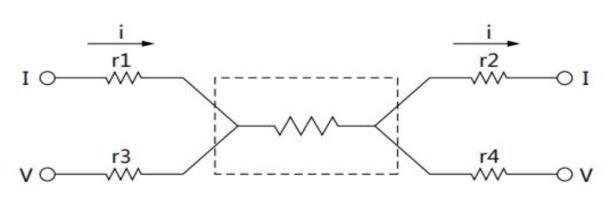
| Table 3-4 Line connection | |
|
For low resistance resistance (less than 10 Ω), the increase in the resistance and temperature coefficient of the copper pin exceeds the resistance itself. A four-legged Kelvin connection is recommended, as shown in the figure below.
|
Support Customization
Hot Tags: low temperature drift current sampling resistor, China low temperature drift current sampling resistor manufacturers, suppliers, factory, Four wire resistor, Precision Power Type Metal Foil Sampling Resistor, Metal foil sampling resistor, High Precision Power Sampling Resistor, Sampling resistor, Low Resistance Metal Foil Sampling Resistor
Send Inquiry
You Might Also Like


